Sunday, April 01, 2007

I Hope It's Not Just Me Who Howled...

Saturday's episode of Doctor Who featured a great ad related quip.

When a bunch of alien creatures in black with big helmets were storming through the hospital building, the girl asked:

"Where are they from, the planet Zovirax?"

Genius. All the more reason to love that show.


Aliens: (right) Pic from BBC Dr Who site.

Saturday, March 31, 2007

Buy Now - We Know Where You Live


While we are all here talking about brands and products; people over in Asia are making real progress in the definitions of what ads can be.

Take for example a guy named Chou Cheng-bao, supposedly of a Taiwanese gang; who sent what was effectively a commercial to a local station threatening to kill a rival gang member (and they aired it).

After all the talk of what brands can learn from Osama Bin laden (I'm sorry, I forget who it was that said it), here is another example to show that the underworld is ahead of everyone in marketing.

From Weird Asian News via Ad Freak

Friday, March 30, 2007

Mortimer and Co's Famous Miracle Brand Formula

Whilst discussing Kevin Roberts' idea from the Future Marketing Summit that brands 'are now owned by the consumer'; several of us (myself, Rob Campbell etc) have concurred that was frankly rubbish, brands have always been owned by the consumer.

I do feel however that what has changed is that the customer now controls the brand, as well as owning it. Where as before the customer protested and the brand took notice (or ignored it); now the consumer has the power to change other people's opinions about it before you can even do anything about it.

I did come up with an analogy I like though:

The situation for brands is rather like that of an early 20th century travelling salesman. Whereas before he could pack up and move town; and change his sales technique before he arrived at the next place... now the people already know what he is selling and whether they are interested before he has even got on his horse.

Thursday, March 29, 2007

Design Mystery No1 Solved!

Finally it has been done.
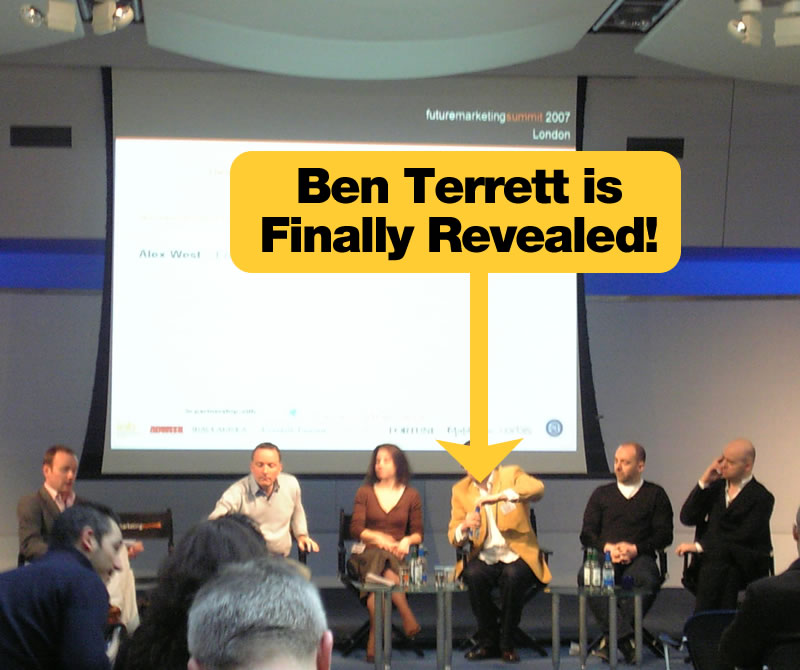
The ad pit can exclusively reveal what every graphic designer worth their salt has been wondering about for several years.

What does Ben Terrett of the Design Conspiracy actually look like?

An exclusive picture from the Future Marketing Summit!

Wednesday, March 28, 2007

Quick Update - Tridon't

Just heard the uk tv ad for Trident chewing gum has been banned after being considered racist.
I will try and find it on my dinner to show you.

Thoughts from those who've seen it?

Here are mine:

What a bloody awful ad. I can see what it's trying to do, make a chewing gum brand into some kind of trendy renegade brand. I really do get the impression that this is a client who has absolutely no understanding of just how little their product or brand means to anyone, even their loyal customers.

I don't think it's particularly racist, but its so badly written that it makes the actor appear stupid and stereotyped by the content.

I almost don't want to show the ad because that will only give it publicity, but for your benefit (thanks to Doug) its here. I get the strong impression Trident are going to walk into the next agency office and say "id like a You Tube viral please". Because if thats not the case, then someone at their agency is suffering from major 'cliche' avoidance syndrome.

Jeez.

Tuesday, March 27, 2007

Neinsteins Theory of Advertivity

One thing that always puzzles me is why planners (and designers and creatives as far as I know) always obsess about theories and theoretical charts. Is it a good thing or are we losing track of the bigger picture?

Recently our blogosphere has seen debates on big ideas vs small ideas, prog vs punk ads and so forth. But is it not the case that there is no right answer?

I like electronica, but I know not to play it at a Slayer gig. I like heavy metal, but I know not to play it at a wedding. Why is it that we often try to fit one type of music to every event, surely the best type of solution is the one that is most relevant to the brief and client?

Its also the case that even when a theory is right, it doesnt always stay that way. Einstein's theory of relativity has been effectively challenged on many occassions. Just because Bernbach and Lever were right back in the 50's and 60's doesnt mean they are 100% right now, but it also doesnt make them wrong.

So.

Do we theorise too much? Or are we justified to do so providing we always stay true to the needs of brands and clients? Or am I wrong too?

Sunday, March 25, 2007

Future Marketing Summit Day Two - Part 6

A big update will follow with the best videos of ads shown at the summit, and also the best pictures of the event. Including some good slides!

Now my thoughts (part one…possibly)

Kevin was right to say that the power of brands is shifting to the consumer; and he is also on the right track with the idea that one media will not replace another, they will become another in a list. For example, while TV as a medium is shrinking, people might soon watch it on their mobiles or their portable media players or Freeview handhelds; and this may prevent much of the predicted reductions.

However, is what he said that revolutionary? Probably not. He seems to give us a lot of the questions with few of the answers. Idealistic thinking is all well and good, but clients don’t buy ideals. And as much as I’d like to see the end of Return on Investment as a model, I can’t see clients ever giving up on it. Because regardless of whether that return is measured in sales, opinions, brand equity or even involvement (as Kevin Roberts stated); clients are still measuring against their budgets and their spend. Investment is always investment regardless of how it is named.


One point I think will become important on the issue of entertainment and risk taking, is that now the viewing of ads is becoming more about choice and less about forced ad breaks; I believe that will are going to have to start changing as well.

Bad ads could work when people have to watch them, but when people choose what to watch, they stand less chance for success. As Russell put it, the business model for crap is disappearing.


I certainly agree with Rob Campbells comments that some of the speakers were very good at telling us what needed to be done, but not so good at telling us how it should be done.

My favourite panel was the Technology panel; and myself, Ben and Beeker agreed that the one person we would really like to see do a full talk next year is Richard Huntingdon; his introduction was great, and he is someone with a good vision of the future.


Overall I think the event was extremely informative for me. Both in terms of the state of marketing, and the future we are heading towards. It also gave me much encouragement that despite not being directly in advertising yet; my thoughts are actually on the right track. The big question is whether this is all just talk, and the real moment of change will be when the giant monolithic agencies start to genuinely move rather than just having a small office somewhere with a “Head of Digital”.

Its seems like marketers and advertisers are starting to head in the right direction, though it appears like many are still relying on their sat-nav; and we all know that can be dangerous…

Future Marketing Summit Day Two - Part 5

Next were Google and BBH to discuss the joint British Airways and Google Earth advertising.

The ads featured shots using Google earth, with cloud pricing. While the site was designed to let you view the destination, but with a cloud image with the BA price on!

One highly interesting point was on the net ads, Google intentionally asked BA to lower the Google branding and increase the BA branding on overlay ads because Google didn’t want to be associated with ads that get in the way of sites.


--------------------------------------------------------


Lastly, was Jon Hamm, the founder of Greenroom digital.

He discussed how this is an exciting time for agencies and clients, a time to take risks, to become even more creative.

He also mentioned how media consumption is becoming more and more chaotic, and how the power of social media is still increasing.

An interesting point he gave was about the nature of ‘viral’ distribution is moving to ‘resonate’ and ‘right place’ distribution. Its not just about putting a funny video up, its about putting it in the right place and making it resonate with the public.

One good point was how measuring views is not the only important metric anymore, it’s about how many people in the core audience viewed it, what did they say, and what sort of response it got.


-----------------------------------------------------


After all these interesting people, it was left to Douglas Broadley of Imagination to sum up. Here are his major points.

“Amazing!” – What an insight!

The gloss of Kevin Roberts words was appealing, but things are not always that glossy in real life.

The idea of owning a conversation is ridiculous…

Agencies forgot to make a plan B! Hence all the recent panic!

The continuing difficulty in finding people who can move between disciplines.

Those who are quick on their feet will succeed.

Integration should just happen, but people get in the way. Integration is not a ‘nice to have’, it has to be meaningful.

Meaning will engender greater belief, which will help engage.

We need to define what unites brands and corporate cultures.

Integration is about Integrity.

People talk when you are found not to be true to their meaning, you can no longer be dishonest, people will find out.

I think this guy knows his stuff. A good choice to sum up.

Saturday, March 24, 2007

Future Marketing Summit Day Two - Part 4

Day Two continued:

Next was the Entertainment panel. Here are some of the key points:

This discussed the need for a reason for people to watch content, and the empowerment of new models of viewing.

40 thousand videos are uploaded to You Tube every single day, and 90% of it is crap. However, we have to remember that most of that 90% is not designed for everybody, its things for a small circle of friends.

Clients are starting to see the need for quality, and the need for entertainment. Though someone in the audience made a great point that sometimes content can be informative rather than entertaining.

Is engagement more important than entertainment?

There is apparently a huge difficulty in finding people who don’t think in terms of print or tv ads. Shall I wave?

Clients have to accept that control of their brands has slipped through their hands.

Another good point is how the system of peer to peer sending that drove much online/viral content is moving to a model of discussion. For example: One of the key things about You Tube is that each video has a discussion area below it, allowing debate to spark.

-----------------------------

Next up was Matt Smith of The Viral Factory. Here are some of his key points:

The internet is now a consumer channel just as much as it is a brand channel.

The ratio of good user generated content to shit is huge.

He spoke about the issue of brands wanting “to do viral” but having no understanding of how it works. The odds are for many brands that if people do care, they care in a negative way.

One problem of asking people to do UGC is that you can end up disappointing people who (despite putting effort in) produce crap content by not using it.

Don’t stake your campaign on viral, as he rightly points out; many people expect to put a video on You Tube and have it automatically get seen by 2 million people, but it simply doesn’t work like that.

Respect creators and consumers, they gave a good example of a great Samsung viral they did, and when someone created their own version they worked with them.


Viral Factory Samsung Viral


Consumer Generated Version

Friday, March 23, 2007

Why Guerrilla Marketing isnt Dead

I must interrupt my Future Marketing Summit posts (one update left plus my views to come!) to mention a fantastic piece of Guerrilla/Ambush marketing on behalf of the Xbox 360.

As you may know, the PS3 launched yesterday in the UK; to surprisingly little enthusiasm. It sold well, but not with the mania we expected.

However, some kind people went and handed out free camping chairs to those who were waiting outside stores before they opened.

The chairs have written on the back "Shouldnt have kept you waiting", and the url www.shkyw.org.

Which of course...